


01
Researchers and analysts
A research session is a talk, a podcast, a recorded call and a Reel. Put them all through one AI summarizer and compare like with like.
One summarizer for video links, audio files and your own uploads.
This is what came back for “Inside the Mind of a Master Procrastinator | Tim Urban | TED”, taken straight from its result page. Nothing here was written for this page.

Inside the Mind of a Master Procrastinator | Tim Urban | TED
TED
Procrastination is driven by a psychological conflict between the Rational Decision-Maker, who plans for the future, and the Instant Gratification Monkey, who constantly chases immediate and easy pleasures. While deadlines manage to activate the Panic Monster to force completion of urgent tasks, open-ended life goals—such as career ambitions, relationships, and health—lack deadlines and therefore never trigger this alarm. Consequently, this invisible, long-term procrastination can linger indefinitely, leaving people feeling like helpless spectators in their finite lives.
An AI summarizer reads long content and writes a short version that keeps what matters. This one is built for things you listen to — videos, podcasts, lectures, recorded calls — and works from the full transcript, so the summary reflects what was actually said rather than a title and a description.
What makes a summary trustworthy is being able to check it. Every point links to the second it came from and the transcript stays on the page, so confirming a claim is one click instead of taking a model's word for it. And because everything is built from that one transcript, the same source also gives you chapters, a mind map, flashcards and answers to your questions.
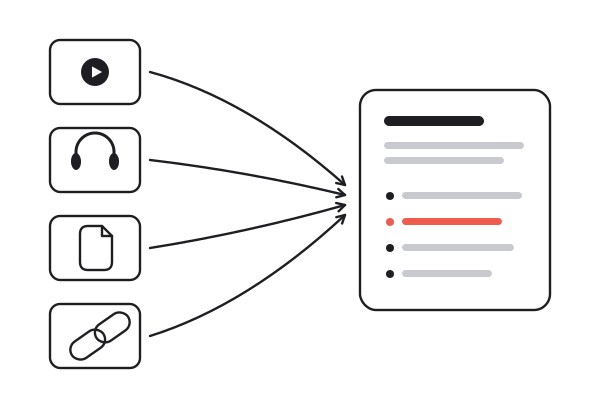
A YouTube, TikTok or Instagram link, a direct media link, or a video or audio file up to 100 MB.
Captions are read in seconds; anything without them goes through speech-to-text first. The summary is built from that transcript.
Start at Gist, open Full notes, the mind map or the flashcards, or ask the chat a question.
Video links, Reels, TikToks, media links and your own audio or video files go into the same AI summarizer and come back in the same shape.
Three depths of the same summary, made together, so moving between them waits for nothing.
A long recording split into named sections, so you can jump to the part you came for.
Topics and sub-points laid out as a map, each linked to its timestamp, downloadable as a PNG.
Question-and-answer cards drawn from the content, editable before you export them to Anki or Quizlet.
Ask anything about the video; the answer comes from the transcript, with the timestamps it rests on.
Summarize a German lecture in English or an English podcast in Japanese; the transcript keeps the original.
Everything you summarize is kept, and search runs over the full text of every transcript.
Every source in one box
01 / 08Video links, Reels, TikToks, media links and your own audio or video files go into the same AI summarizer and come back in the same shape.
Three depths of the same summary, made together, so moving between them waits for nothing.
A long recording split into named sections, so you can jump to the part you came for.
Topics and sub-points laid out as a map, each linked to its timestamp, downloadable as a PNG.
Question-and-answer cards drawn from the content, editable before you export them to Anki or Quizlet.
Ask anything about the video; the answer comes from the transcript, with the timestamps it rests on.
Summarize a German lecture in English or an English podcast in Japanese; the transcript keeps the original.
Everything you summarize is kept, and search runs over the full text of every transcript.
A research session is a talk, a podcast, a recorded call and a Reel. Put them all through one AI summarizer and compare like with like.
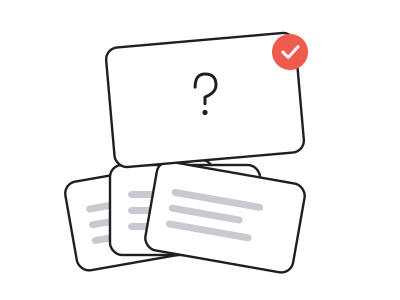
Turn a recorded class into a summary to post, chapters for the replay and a deck of cards for revision.
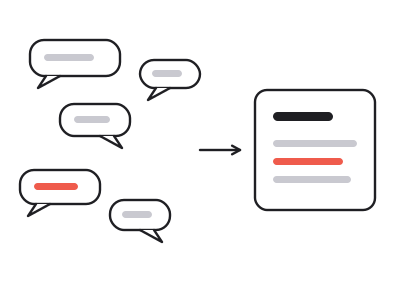
Read what a competitor's webinar, ad and short videos actually say, and what their comment sections say back.
Keep the transcript in the language you are learning and read the summary in the one you already know.
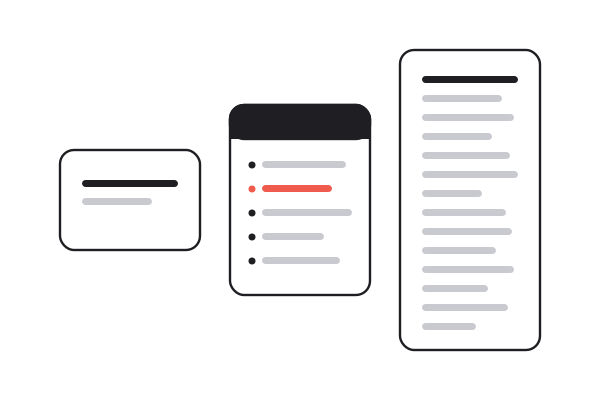
Gist is a few sentences: enough to decide whether a source deserves your time. Brief is the argument with its main supporting points. Full notes is close to what a diligent person would have written while listening, section by section.
The AI summarizer prepares all three together, so switching between them waits for nothing and costs nothing more. Read the Gist of five sources, then open Full notes only on the two that matter — the triage a reading list gets, applied to video and audio.
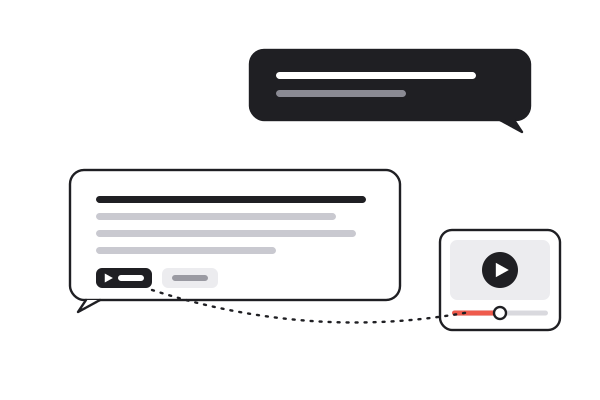
A summary answers the question you did not ask yet. When you have a specific one — what did she say about pricing, which study did he cite — ask it in the Chat tab. The answer is drawn from the transcript only, and each one carries the timestamps it rests on.
When the source never covers your question, the answer says so plainly instead of filling the gap. That is what separates an AI summarizer built on the transcript from pasting it into a general chatbot: the route back to the exact moment survives, and nothing is invented to sound complete.
Three ways to get the gist of a long recording. Only a dedicated AI summarizer gives you every format at once and lets you check each claim at its source.
| Watching or listening | Pasting it into a chatbot | summarizer.video | |
|---|---|---|---|
| Works on links and your own files | Only text you paste | ||
| Every point linked to its second | |||
| Summary at three depths | Ask again each time | ||
| Chapters, mind map and flashcards | Prompt by prompt | ||
| Says so when the source is silent | Not reliably | ||
| Searchable history of every source |
Reading anything already summarized is free, with no account. Summarizing something new runs on credits, and a new account starts with ten. Reading existing captions is one credit, the summary is one more, and speech-to-text is 1 credit per minute of audio.
YouTube, TikTok and Instagram links, direct media links, and your own MP4, MOV, MP3 or WAV files up to 100 MB. Anything with speech in it works; it is built for spoken content, not text documents.
Yes. Upload the recording as an MP3 or WAV file and it goes through speech-to-text on any account, then gets the same summary, chapters and transcript as a video.
The timestamps survive. A chat assistant returns fluent prose with no route back to the source; here every point carries the second it came from, the transcript stays beside it, and the chat says so when the video does not cover something.
Gist is a few sentences, Brief is the argument with its main points, and Full notes is close to a careful note-taker's page. All three are made together, so switching between them is instant.
Yes. The output language is independent of the spoken one, across eight languages: English, Chinese, Spanish, Japanese, Portuguese, German, French and Korean. The transcript stays in the original.
Free accounts take videos up to ten minutes and an hour of uploads a month. Paid plans have no length limit, and the chapters keep a three-hour recording easy to move around in.
Yes. The Chat tab answers from the transcript only, cites the timestamps each answer rests on, and tells you plainly when the source does not cover your question.
Ten credits when you sign up, uploads on every account. No card, no countdown.
Paste a link or drop a file